No one talks about sleep the way they do about training, nutrition, or taking supplements, even though this factor is the one that most directly determines how effectively all the other factors work.
When sleep is disrupted, everything related to it is disrupted as well. Growth hormone production decreases, and muscle protein synthesis slows down. The next morning – and for days to come – cognitive function suffers. And all of this is simply because you’re not sleeping well.
Peptides for sleep and peptides for recovery have sparked serious interest among researchers precisely because they don’t take a one-size-fits-all approach. For example, doses of melatonin supplements often significantly exceed physiological levels and, as a rule, shift circadian rhythms more than they improve sleep depth. Benzodiazepines suppress the REM sleep phase. Antihistamines knock you out and leave you in a fog. What researchers are studying with sleep peptides and recovery peptides is something different: compounds that work with the body’s existing sleep architecture.
That’s why today the Iron Peptides team is introducing you to sleep peptides: DSIP peptide and growth hormone-releasing peptides (GHRPs).
Why Sleep Is the Foundation of Every Recovery Protocol
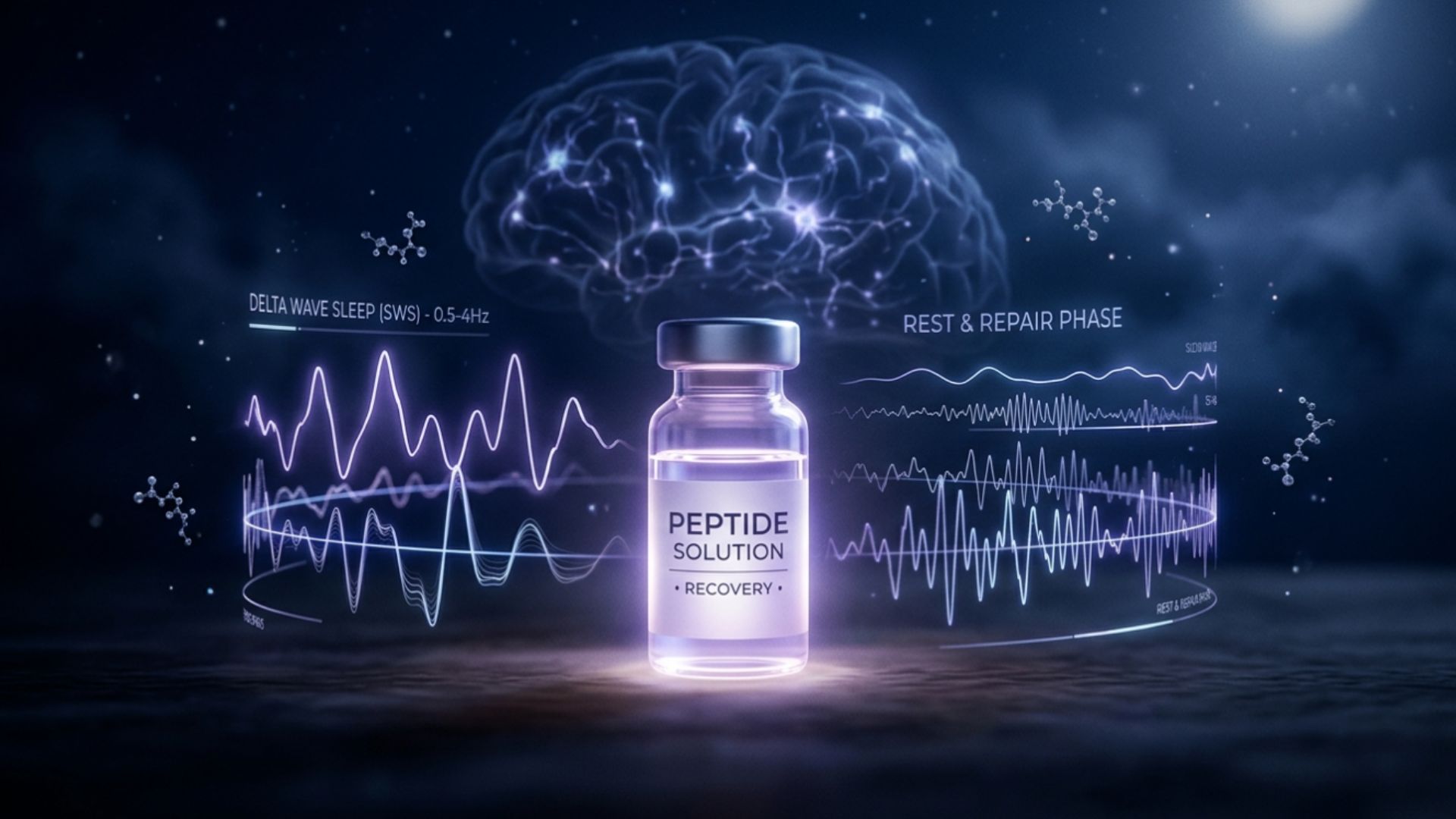
During slow-wave sleep, the anterior pituitary releases the majority of its daily growth hormone output in pulsatile bursts. This is when muscle protein synthesis peaks, when the glymphatic system – the brain’s waste-clearing network – runs at full capacity, and when the autonomic nervous system shifts into the recovery state it can’t access during waking hours. Skip or shorten slow-wave sleep consistently, and you’re cutting off the biological processes that make training adaptation, injury repair, and cognitive consolidation possible.
This is why sleep peptides aren’t a fringe category. For anyone running serious recovery protocols, sleep quality is the multiplier that determines how much of everything else actually sticks.
Traditional sleep medications mostly improve subjective sleep quality by suppressing arousal, not by improving sleep architecture. Some actively reduce the slow-wave and REM stages that matter most. Recovery peptides and peptides for muscle recovery are being studied in part because the existing pharmacological toolkit does a poor job of enhancing what deep sleep actually accomplishes, rather than just shortening the time it takes to lose consciousness.
How Peptides Influence Sleep Architecture
The compounds most relevant to sleep research work through distinct mechanisms, which is exactly why combining them makes more sense than choosing one.
DSIP (covered in detail below) modulates neurotransmitter systems involved in sleep stage regulation, including interactions with GABA and somatostatin pathways. GHRPs stimulate pulsatile growth hormone release from the pituitary, amplifying what the body is already doing during slow-wave sleep. The research interest is specifically whether these compounds can deepen and extend the stages of sleep where recovery actually occurs, rather than just increasing total time spent unconsciously.
Peptides for sleep that target different nodes of this system simultaneously – one working on sleep stage depth, another on the GH pulse that should accompany it – are the basis for the stacking protocols we’ll get to at the end.
DSIP Peptide: The Deep Sleep Inducer Researchers Trust
The DSIP peptide (Delta Sleep-Inducing Peptide) is a naturally occurring nonapeptide – nine amino acids, sequence Trp-Ala-Gly-Gly-Asp-Ala-Ser-Gly-Glu. It was first isolated from the cerebral venous blood of rabbits in 1977 by Monnier and colleagues. What made it interesting from the start was the observation that infusing it into recipient animals induced delta-wave (slow-wave) sleep states. The name followed directly from the observed effect.
Human research on DSIP peptide for sleep has been more limited but still meaningful. A double-blind, placebo-controlled study by Schneider-Helmert (1987, Neuropsychobiology) investigated DSIP administration over 7 consecutive nights in patients with chronic insomnia. The results showed substantial improvements in sleep efficiency and daytime alertness, with effects persisting into the first post-treatment night. Total sleep time increased, nighttime awakenings decreased, and daytime psychological performance improved – reaching levels comparable to healthy control subjects.
The most notable DSIP peptide benefits observed across this research: reduced time to sleep onset, increased NREM sleep time, fewer nighttime awakenings, and improved daytime alertness the following day. Unlike sedatives, DSIP appears to function as a sleep modulator – subjects wake up feeling rested rather than residually impaired, which is clinically significant. Additional research has also examined DSIP’s role in stress modulation, with evidence suggesting it may help regulate cortisol rhythms – relevant for anyone whose poor sleep is driven by HPA axis dysregulation rather than a primary sleep disorder.
DSIP Peptide Dosage and Timing for Optimal Results
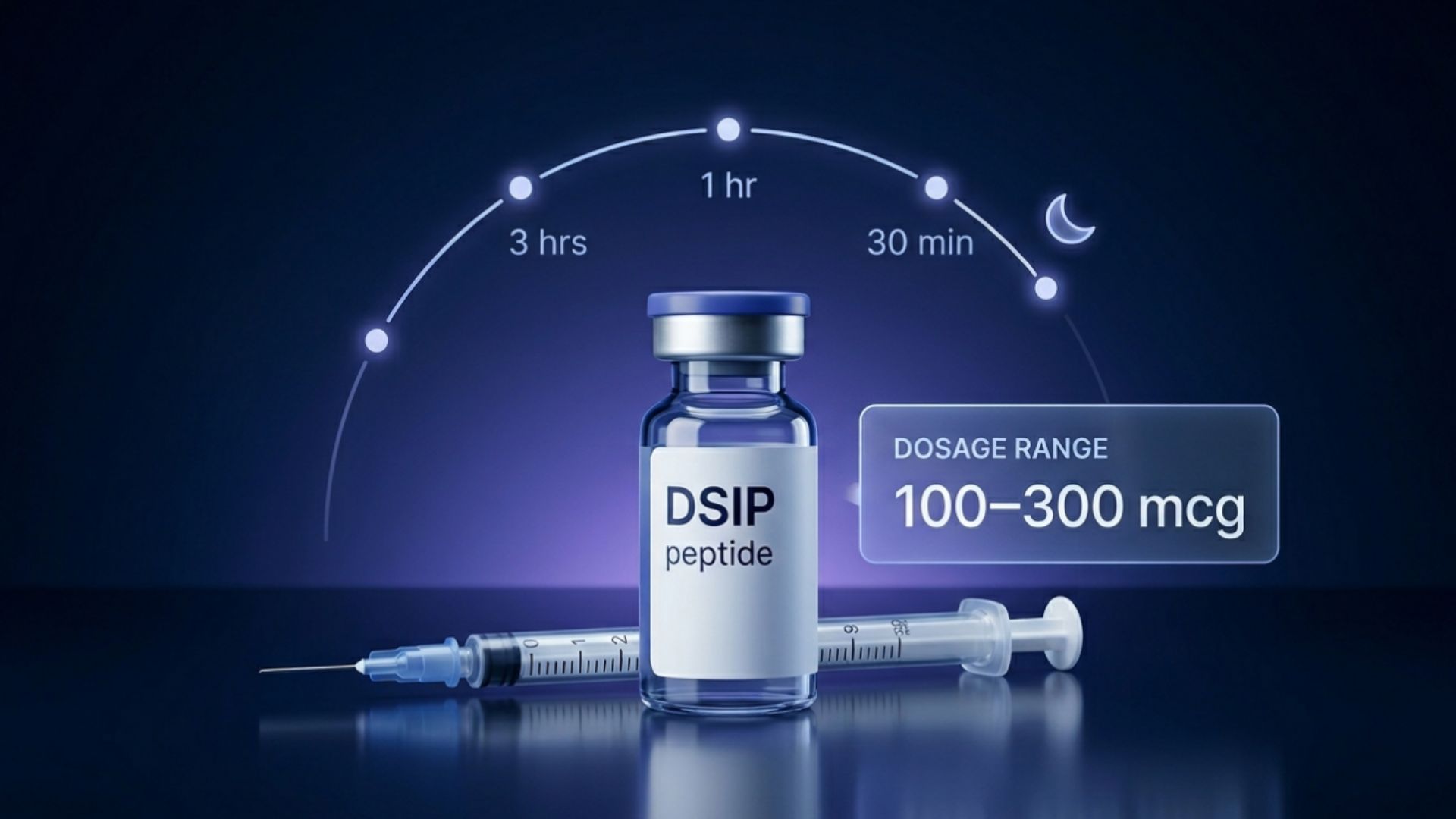
DSIP peptide dosage in the research literature varies by study design and administration route. The Schneider-Helmert human studies used intravenous administration; most current research protocols use subcutaneous dosing, 15-30 minutes before sleep. This pre-sleep timing is intentional – it aligns DSIP’s activity with the body’s natural circadian rhythm toward sleep.
Starting at the lower end of the dosing range and assessing response before adjusting is standard research practice. Cycling is also worth noting: receptor desensitization is a concern with consistent long-term use of any neuropeptide, and most protocols include off periods (commonly 5 days on / 2 days off, or 4-8 week cycles with breaks).
DSIP peptide quality matters enormously here. A compound with this level of biological sensitivity produces unreliable results if the product is underdosed or contaminated – which is exactly why we test every batch at Freedom Diagnostics with HPLC and mass spectrometry, and publish COAs publicly by lot number. Inconsistent results from DSIP research are often due to sourcing issues, not a compound problem.
GHRPs: The Other Half of the Nighttime Recovery Equation
Growth hormone-releasing peptides – Ipamorelin and CJC-1295 being the most common combination – address the hormonal side of the overnight recovery equation.
Ipamorelin was characterized in a landmark 1998 paper by Raun et al. (European Journal of Endocrinology) as the first selective GH secretagogue – meaning it stimulates pituitary GH release with specificity comparable to GHRH itself, without the ACTH and cortisol elevation seen with earlier GHRPs like GHRP-2 and GHRP-6. That selectivity profile makes it particularly well-suited to nighttime protocols: a GH pulse without unwanted hormonal side effects.
CJC-1295 extends the duration of that signal. A 2006 human study by Teichman et al. (Journal of Clinical Endocrinology & Metabolism) documented dose-dependent 2- to 10-fold increases in mean plasma GH concentrations, sustained for 6 or more days after a single injection, and IGF-1 elevations lasting 9-11 days. For nighttime protocols using CJC-1295 No DAC (the shorter-acting variant), the mechanism is a strong but temporally bounded GH pulse that more closely mimics natural pulsatile secretion. This is why this is the preferred form for pre-sleep use.
The combination of CJC-1295 and Ipamorelin is specifically why these are considered among the best peptides for recovery – they activate complementary pathways for a GH signal that’s broader and more complete than either compound produces alone, and they time that signal to overlap with slow-wave sleep’s natural GH secretion window.
Building an Effective Nighttime Peptide Protocol
The most studied combination for overnight recovery is DSIP combined with Ipamorelin and CJC-1295 No DAC, administered subcutaneously 20-30 minutes before sleep.
DSIP deepens sleep architecture. The GHRP/CJC stack triggers a GH pulse that aligns with the deeper, slow-wave window during which DSIP is expanding. The mechanistic logic of the combination is straightforward – each compound works on a different node of the same overnight recovery process.
Peptides for recovery protocols sometimes layer additional compounds for specific goals:
- BPC-157 for active tissue repair during the overnight window
- Thymosin Alpha-1 for immune support during high training loads
- Selank for anxiety-driven sleep disruption
The principle is always the same – start with one compound, establish a baseline, then add compounds with clearly complementary mechanisms.
Proper reconstitution with bacteriostatic water, cold-chain storage, and accurate dosing are non-negotiable for any of this to work as described in the literature. We carry bacteriostatic water in 3ml and 10ml formats alongside the compounds specifically for this reason.
This is research-focused information. Anyone building a peptide protocol should do so with input from a qualified professional.
Final Thoughts: Choosing the Best Peptides for Your Recovery Goals
Sleep is where recovery actually happens. You can optimize every other variable in a protocol and still plateau if slow-wave sleep is shallow, fragmented, or insufficiently long. Peptides for sleep, like the DSIP peptide and GH-releasing compounds, aren’t a workaround for poor sleep habits – they’re a targeted research tool for people who understand what deep sleep is doing biologically and want to support it more deliberately.
The best peptides for recovery in a nighttime context come down to DSIP for sleep architecture, Ipamorelin + CJC-1295 for the GH pulse that should accompany deep sleep, and – depending on individual goals – additional compounds layered onto that foundation with specific mechanistic rationale.
Source quality determines whether any of this reflects what the published research describes. Under-dosed or degraded compounds don’t produce the results documented in the studies – they just introduce an unknown variable that makes the whole protocol harder to interpret. Every compound we carry is batch-tested and has publicly available COAs before purchase. That transparency is what we’d want if we were on the other side of the decision.
Peptides for recovery used intelligently, sourced properly, and cycled appropriately – that’s where the research and real-world outcomes converge.