Most peptide blends on the market are marketing exercises – take two popular compounds, put them in one vial, give it a name. KLOW is different, and the difference is in what was actually selected and why.
KLOW peptide has become one of the most discussed multi-compound formulas in the recovery and biohacking community over the past couple of years. And all of this is because researchers who’ve run it keep talking about the results. It addresses inflammation, gut integrity, connective tissue repair, and skin regeneration simultaneously, not as four separate protocols, but as one injection that’s hitting all of those pathways at once.
This is the complete breakdown: what the KLOW peptide is, how each component contributes, what the research actually shows, how it compares to GLOW, and what real users are reporting in KLOW peptide before and after.
What Is KLOW Peptide? Breaking Down the Blend
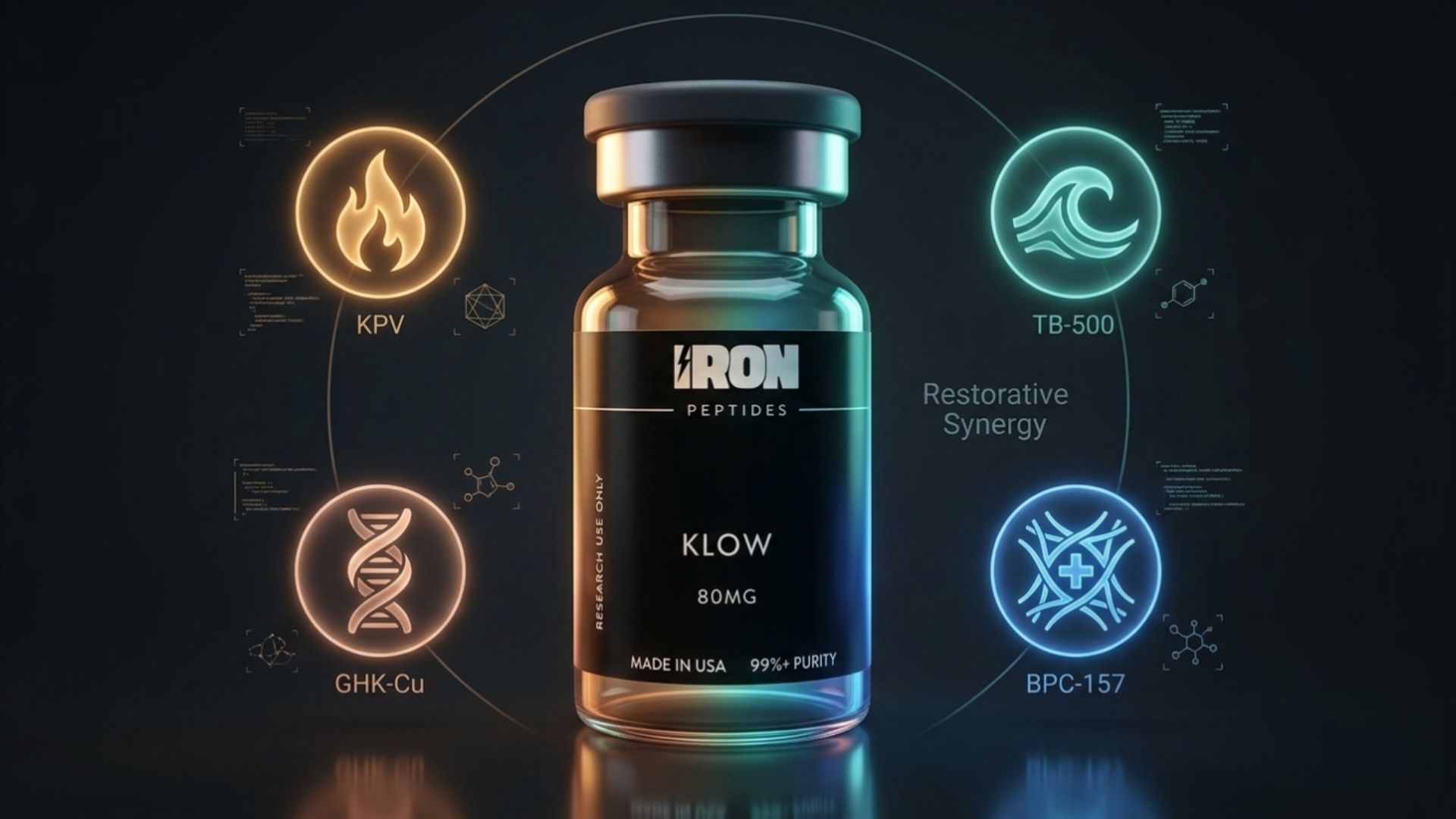
What is the KLOW peptide at its core? It’s a four-component research blend where each letter in the name corresponds to a specific compound or function.
The KLOW blend peptide we carry contains: KPV (a tripeptide derived from alpha-melanocyte-stimulating hormone, known primarily for anti-inflammatory and gut-protective properties), GHK-Cu (a copper-binding tripeptide with well-documented skin, hair, and tissue regeneration activity), and the Wolverine component – which is itself a pre-combined stack of BPC-157 and TB-500, the two most researched connective tissue and recovery peptides in the field.
Each compound is there for a specific reason:
- KPV targets inflammatory signaling, particularly at the gut mucosal level.
- GHK-Cu activates gene expression pathways related to collagen synthesis and cellular repair.
- BPC-157 and TB-500 together address tendon, ligament, and muscle recovery through complementary mechanisms: BPC-157 acting on growth factor and nitric oxide pathways, and TB-500 driving cellular migration and angiogenesis into damaged tissue.
This isn’t a blend that happened by accident. It’s a stack built around the idea that full-body recovery requires addressing multiple systems at once – and that doing it in one vial is more practical than managing four separate compounds.
One important note: formulations vary between vendors. Always read the certificate of analysis for any KLOW peptide blend before purchasing – the COA tells you exactly what’s in the vial and at what concentration.
KLOW Peptide Benefits: What the Research Suggests
The KLOW peptide’s benefits are best understood component by component, as the research behind each component is distinct:
- KPV’s anti-inflammatory mechanism is probably the most rigorously studied element of the blend. Dalmasso et al. (2008) published findings in the Journal of Pharmacology and Experimental Therapeutics showing that KPV reduces inflammatory cytokine expression in intestinal epithelial cells by suppressing NF-kB, a central regulatory switch in the chronic inflammatory response. This is why KPV appears in formulas specifically targeting gut inflammation and systemic inflammatory load.
- GHK-Cu’s regenerative activity is documented across decades of research. Pickart & Margolina’s 2018 review, “Regenerative and Protective Actions of the GHK-Cu Peptide in Human Body Organs,” catalogs GHK-Cu’s ability to activate over 4,000 genes involved in tissue remodeling, skin repair, and anti-inflammatory signaling. The compound’s copper-binding structure gives it a unique role in activating both the cellular repair machinery and collagen synthesis pathways simultaneously.
- The Wolverine (BPC-157 + TB-500) component brings the connective tissue and musculoskeletal recovery piece. Gwyer et al.’s 2019 review in npj Regenerative Medicine specifically highlighted BPC-157’s role in angiogenesis and growth factor signaling across musculoskeletal tissue types – tendons, ligaments, and articular surfaces all studied. TB-500’s contribution is cellular migration via actin upregulation, which drives vascularization into tissue that wouldn’t otherwise have the blood supply to repair itself.
Together, the KLOW peptide targets five distinct areas: systemic and gut inflammation, gut lining integrity, connective tissue repair, skin and collagen regeneration, and overall recovery capacity.
KLOW Peptide Before and After: What Users Are Reporting
KLOW peptide before and after reports across biohacking communities and independent research forums consistently cluster around a few themes.
Joint discomfort reduction within 2-4 weeks is the most commonly reported early signal, specifically in people with chronic low-grade inflammation rather than acute injury. Digestive improvements show up next: reduced bloating, more consistent gut function, and less post-meal discomfort. These reports make sense mechanistically given KPV’s gut mucosal activity. Skin texture improvements are typically reported later in a cycle – consistent with GHK-Cu’s collagen synthesis timeline, which tends to show visible effects after 6-8 weeks of consistent use.
Athletes report faster training recovery and reduced post-workout soreness when running KLOW alongside their regular protocols. Sleep quality improvements come up often in threads where KLOW is combined with evening dosing and DSIP.
Anecdotal reports aren’t clinical evidence. But when the same patterns show up repeatedly across independent users with no financial stake in the outcome, it’s worth paying attention to – especially when the observations align with the known mechanisms of each component.
KLOW vs GLOW Peptide: Which Blend Is Right for You?
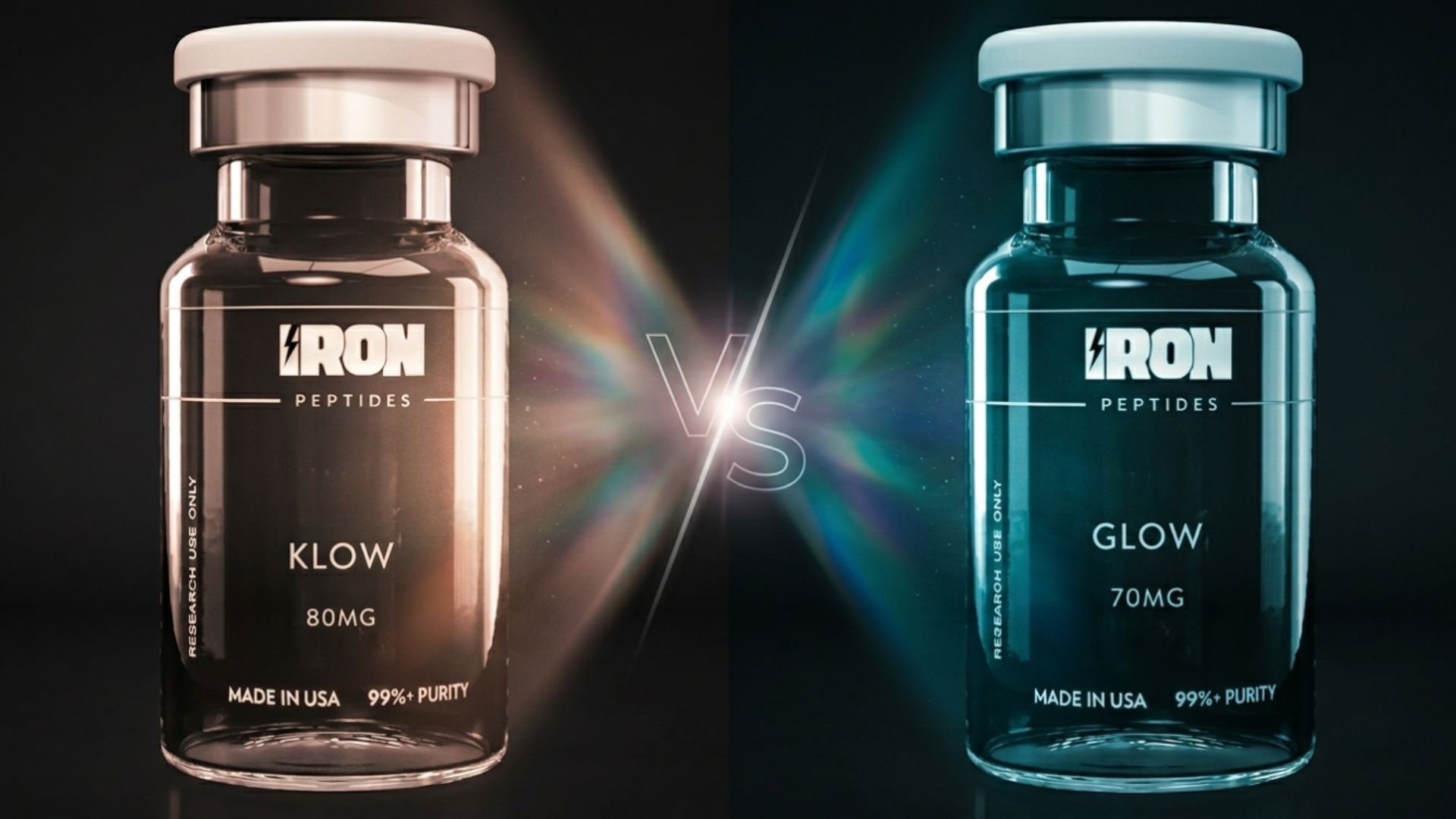
The KLOW vs GLOW peptide question is one of the most common we get, and the answer comes down to the primary goal.
GLOW focuses on aesthetic and regenerative outcomes – it contains GHK-Cu, BPC-157, and TB-500, optimized for skin quality, hair growth, and anti-aging applications. The absence of KPV means GLOW isn’t specifically targeting gut or systemic inflammation – it’s doing tissue repair and skin regeneration.
KLOW peptide adds KPV to that foundation, shifting the focus toward inflammation control and gut lining integrity alongside connective tissue repair. If you’re dealing with chronic inflammation, digestive issues, post-injury recovery, or joint discomfort, KLOW covers more ground. If your primary goal is skin quality and aesthetic regeneration with an otherwise healthy inflammatory baseline, GLOW may be the more targeted choice.
Some experienced researchers cycle between the two depending on their current protocol phase. Others run KLOW for an initial 8-week cycle specifically because of the inflammation-reset effect, then move to GLOW for maintenance. Neither approach is wrong – it’s about matching the tool to the problem.
When to Choose KLOW Over Single-Peptide Protocols
The practical case for a KLOW peptide blend over four separate vials is straightforward: one injection instead of four, one reconstitution process, and one storage vial to manage.
For beginners who aren’t yet certain which individual compounds they respond to, KLOW offers broad-spectrum coverage without requiring the knowledge to design a custom stack from scratch. It’s a reasonable starting point that covers most recovery bases effectively.
The trade-off is precision. When you run KLOW, you can’t adjust KPV independently of GHK-Cu – you’re taking the blend as designed. Researchers who want to fine-tune individual compound doses, or who already know they respond particularly well to one component, may prefer building a custom stack. But for most people starting, the convenience and the synergy of the pre-made blend more than compensate for that limitation.
How to Build a KLOW Stack Peptide Protocol
A KLOW stack peptide protocol typically starts with KLOW as the foundation and builds from there, depending on specific goals.
The most common addition is a GHRP – Ipamorelin or CJC-1295 No DAC, administered at the same pre-sleep time as KLOW. The logic: KLOW deepens the tissue repair signal overnight, and a GHRP amplifies the growth hormone pulse that should accompany it. These two together are more effective for recovery than either alone.
For researchers dealing with sleep disruption alongside recovery goals, adding DSIP to the evening protocol is the natural next step. DSIP specifically deepens delta-wave sleep architecture, which is when KLOW’s repair activity has the most favorable biological environment to work in.
If acute injury recovery is the primary goal – not just systemic maintenance – some researchers add a standalone BPC-157 vial on top of KLOW to increase the total daily BPC-157 load beyond what the Wolverine component delivers. This is a more advanced approach and should be built into the protocol after running KLOW alone for at least two weeks to establish a baseline response.
Standard cycling for any KLOW peptide protocol: 8 weeks on, 4 weeks off. Don’t run continuously without breaks – receptor sensitivity matters for long-term effectiveness.
Final Thoughts: Is KLOW Peptide Worth Adding to Your Protocol?
KLOW peptide has earned its reputation as one of the most versatile multi-compound stacks in the current research peptide space – not through marketing, but through consistency of user-reported outcomes and a component profile that’s actually backed by published research.
The KLOW blend peptide addresses inflammation, gut integrity, connective tissue repair, and skin regeneration in a single injection. KLOW peptide dosage range, depending on protocol phase, with evening administration the standard recommendation. Compared to GLOW, the KLOW vs GLOW peptide favors KLOW when inflammation, gut health, and recovery goals are considered.
What determines whether the KLOW peptide before and after results match expectations isn’t the compound – it’s sourcing, reconstitution, and protocol consistency. A degraded or under-dosed vial doesn’t produce the outcomes the research components would predict. Our KLOW 80 is batch-tested at Freedom Diagnostics, with COAs available for each lot before you order. That’s the verification step worth taking before any research protocol.