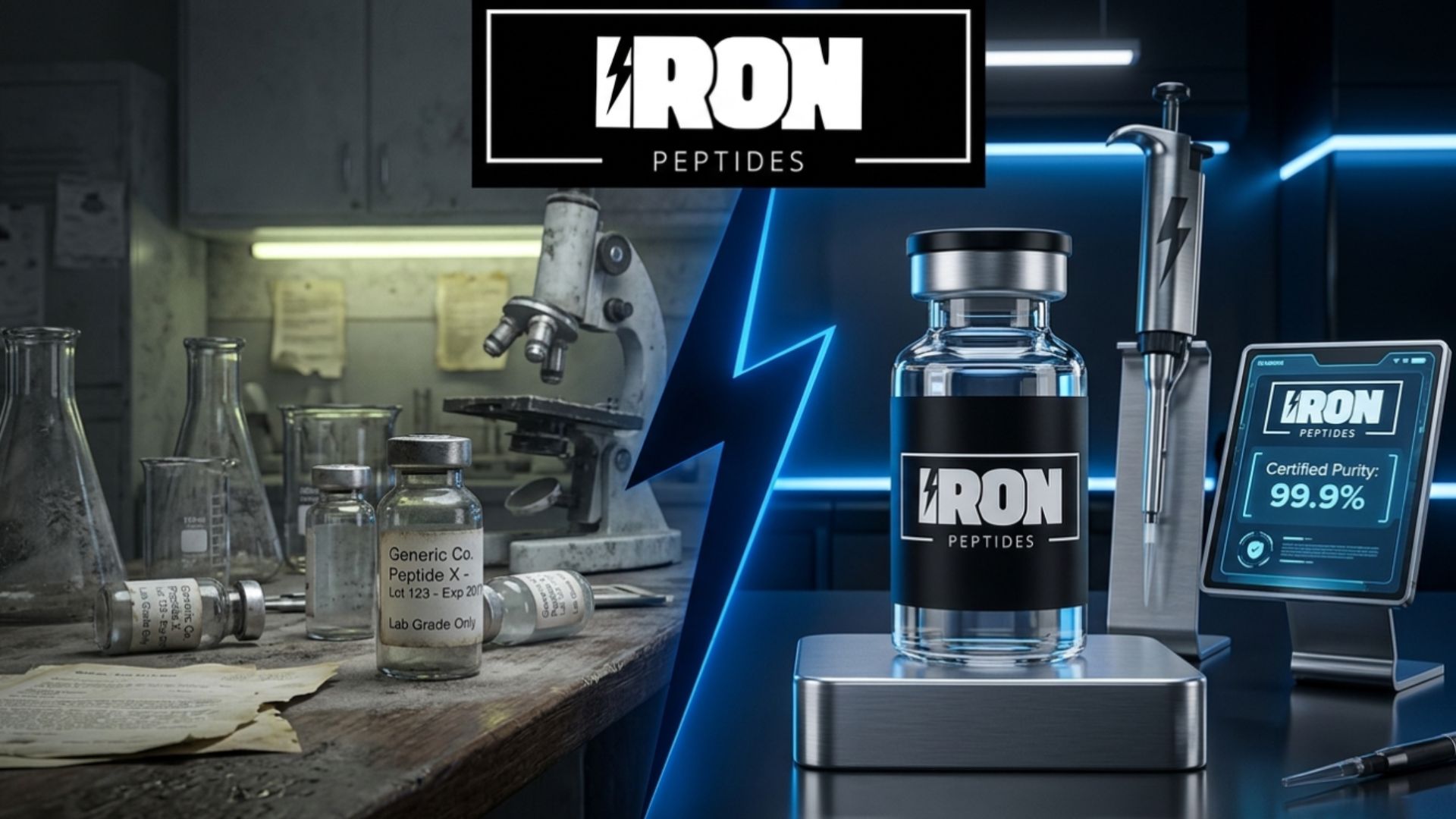
This might sound like a cliché, but it’s true: the peptide market is oversaturated. Some products are genuinely good, but unfortunately, most are not. And the saddest part is that low-quality products don’t advertise themselves. This means you end up buying them, and over time, they undermine your results. And you start to doubt your protocol, even though the real problem lies with the supplier.
Unfortunately, there are many unscrupulous suppliers. To help you avoid making mistakes, we offer our services. But how can you be sure we’re better than the rest? It all comes down to comparison! Let’s conduct a real analysis of how Iron Peptides vs traditional suppliers stack up against each other on key metrics: testing, documentation, purity, delivery, and support.
We’ll examine what peptide vendor reviews in the scientific community consistently highlight, how to cut through the marketing hype to verify what’s true, and a practical framework for choosing a supplier you won’t regret.
The Real Cost of Choosing the Wrong Peptide Vendor
Let’s start where most guides don’t: the actual damage a bad vendor does.
It rarely looks dramatic. An underdosed vial doesn’t come with a warning label. A peptide that degraded during shipping because someone skipped temperature-controlled packaging looks identical to one that didn’t. A certificate of analysis that doesn’t match the actual batch on your bench is a document (but not a guarantee). None of these failures announce themselves – they just show up as protocol results that don’t make sense, wasted weeks, and money spent twice.
The peptide industry operates in a regulatory gray zone. There’s no mandatory testing standard or licensing requirement that forces vendors to publish real lab data. That vacuum gets filled by vendors who prioritize margin. Sourcing from overseas manufacturers with no visibility into process standards. Publishing stock COAs that aren’t batch-specific. Shipping sensitive compounds in plain packaging with no cold-chain consideration whatsoever.
Any honest peptide supplier comparison starts here – who actually controls what goes into the product and who’s willing to prove it. That’s the only question that matters, and most vendors quietly hope you won’t ask it too hard.
How to Spot Fake Peptides Before You Buy
How to spot fake peptides before committing to a vendor comes down to a short list of verifiable signals – most of which don’t require a lab.
Start with the COA. A legitimate Certificate of Analysis is batch-specific – meaning the lot number on the document matches the vial’s lot number. It’s issued by a named, independent third-party laboratory (NOT the vendor’s own internal testing). It includes the test date, the method used (HPLC and mass spectrometry are the standard), and a purity result. If a vendor publishes a single generic COA for a compound with no batch reference – or worse, no COA at all – that’s a hard stop.
Pricing is another signal. The economics of pharmaceutical-grade manufacturing have a floor. If a vendor is substantially underpricing competitors across the board, something in the process has been cut. That something is almost always testing, sourcing transparency, or both.
Beyond documentation: look for batch numbers on the vials themselves, proper temperature-indicated packaging, and independent reviews that aren’t hosted on the vendor’s own platform. How to verify peptide quality isn’t complicated – it just requires looking at evidence rather than marketing copy. We publicly publish our COAs from Freedom Diagnostics, batch by batch.
How to Choose a Peptide Vendor You Can Actually Trust
Knowing how to choose peptide vendors in this market means having a framework that doesn’t start with price.
Third-party lab testing is non-negotiable – HPLC and mass spectrometry, batch-specific, from a named external lab. That’s the baseline. From there, the questions get more specific:
- Are those documents publicly accessible before purchase, or are they only available upon request?
- Does the vendor manufacture in-house under auditable standards, or are they reselling from unverifiable sources?
- Does cold-chain shipping come standard, or is it an upgrade you have to request?
Let’s take our PT-141 10MG as an example. As soon as you visit the product page on our website, you can find all the information about it. Just scroll down a bit, and where the description is, you’ll see a COA tab. Open it, you’ll see the independent lab that tested our peptide and reported a purity of 99.877%. Furthermore, this test includes the website (which conducted the independent analysis) and a code. This means you can visit the site yourself and use the code to verify whether an independent assessment actually took place and what the actual result was. We have nothing to hide, and we’re ready to share this information openly.
Purity should consistently hit 98% or higher. Customer support should be reachable through multiple channels and staffed by people who can actually discuss product specifications – not just track orders. Product descriptions should include reconstitution guidance, storage requirements, and batch references. And the catalog itself should be a signal: a curated list of well-researched, high-demand compounds suggests a vendor making deliberate decisions.
That last point matters more than it seems. The best peptide vendor comparison isn’t about who carries the most products. It’s about who can stand behind every product they list. Bloated catalogs with inconsistent quality are exactly how researchers end up with a great result on one compound and a useless vial on the next.
Iron Peptides vs Competitors: A Side-by-Side Reality Check
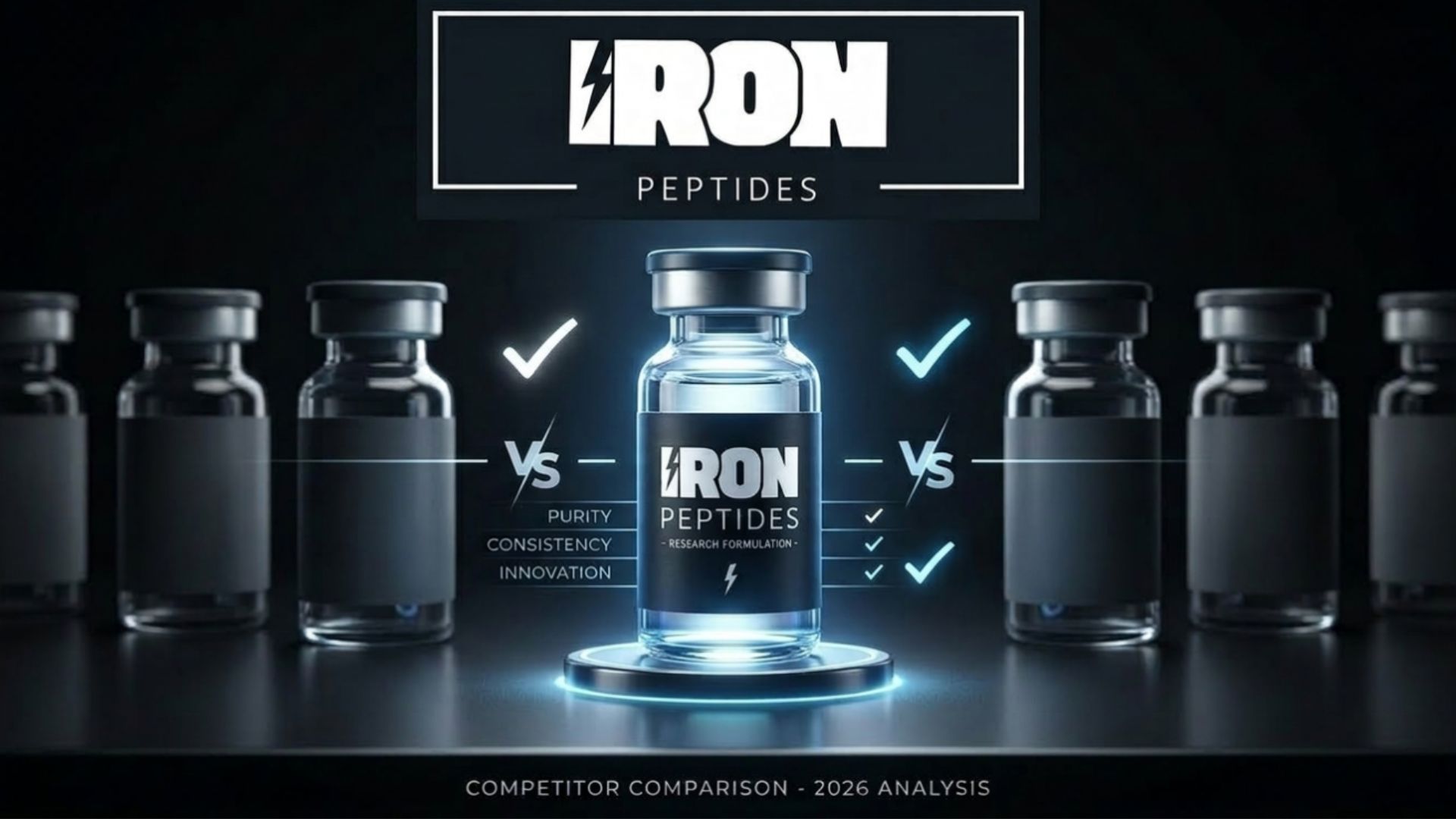
In a straightforward Iron Peptides vs competitors breakdown, the gap shows up in the operational details, not the marketing.
Generic vendors typically offer lower entry prices. They often carry larger catalogs, and their websites can look polished. But pull at the documentation, and the picture changes fast: COAs that aren’t batch-specific, deliberately vague sourcing language, cold-chain shipping that’s optional or nonexistent, and customer service that responds to complaints with delays and form letters.
Every batch we ship has been independently tested at Freedom Diagnostics using HPLC and MS. The COA for that specific batch – with the lot number matching your vial – is available to download from the product page before you buy. Our purity consistently exceeds 99%. We manufacture in FDA-registered, cGMP-compliant facilities in the US. Cold-chain handling isn’t an add-on; it’s how we ship.
The honest version of this peptide supplier comparison comes down to one thing: what are you actually paying for when you go cheaper? In most cases, you’re absorbing the risk that the vendor externalized. Inconsistent purity. Degraded product from improper storage. Researchers who’ve made that trade once rarely make it twice.
What Peptide Vendor Reviews Reveal About Iron Peptides
The most useful place to evaluate any vendor isn’t their homepage – it’s the forums, biohacking communities, and independent review platforms where people write without an incentive to be generous.
Peptide vendor reviews about us across those channels run through consistent themes: products that perform on par with pharmacy-grade reference compounds, genuinely fast shipping (next-business-day dispatch, 2-5 days domestic), packaging that properly handles temperature-sensitive compounds, and support that provides real answers. Researchers who switched from generic suppliers specifically mention noticing the consistency difference – same protocol, better results, and documentation that actually matches what arrived.
That pattern in peptide vendor reviews isn’t something we manufactured. It’s what happens when the testing and shipping standards we hold internally translate into what a researcher actually opens on their bench.
Why Iron Peptides Stand Apart from Other Vendors
The case for Iron Peptides vs other vendors isn’t built on one standout feature. It’s built on the combination of holding together across every order.
How to choose a peptide vendor for serious research means asking: Will the product be what the label says it is, every single time? Our answer is a publicly verifiable yes. Every compound in our catalog is third-party tested, and every shipment meets the handling standards that peptide stability actually requires.
We also treat education as part of the product. Our site includes a built-in Peptide Calculator for dose volume calculations, and our compound descriptions go beyond marketing language to include practical storage and reconstitution guidance. The best peptide vendor comparison should account for this – because a vendor that helps researchers use products correctly is fundamentally different from one that just ships a vial and disappears.
How to verify peptide quality is a skill researchers should develop. We built our platform specifically to make that verification easy, because we’re confident in what the verification will show.
Final Verdict: The Smart Choice for Serious Researchers
The peptide research community has tolerated inconsistent vendors for too long, mostly because the alternative wasn’t obvious. The Iron Peptides vs traditional suppliers comparison makes it obvious.
How to spot fake peptides comes down to documentation – batch-specific COAs, named labs, verifiable purity. How to choose a peptide vendor comes down to who meets those standards on every order, not just the first one. Peptide vendor reviews across independent platforms consistently confirm that we do. And in any real Iron Peptides vs other vendors evaluation, the gap isn’t close on the metrics that actually affect research outcomes: purity, consistency, transparency, and support.
Vendor reliability isn’t a secondary consideration. It’s the foundation everything else rests on. Visit our site, review the certificates of analysis for whatever you’re sourcing, and compare against what any other vendor is willing to put in writing. That comparison is one we’ve always been comfortable having.