You can purchase the highest-purity peptides on the market, pay for an independent analysis, and select the right compound for your protocol… But then lose all your investment in a week due to improper vial storage. Unfortunately, statistics show that this happens more often than you might imagine.
Peptides are sensitive molecules, and that is precisely why they require proper storage. Heat destroys them, light damages peptide bonds, humidity causes hydrolysis in powder form, and oxygen causes oxidation. And as soon as you add bacteriostatic water, a whole new set of vulnerabilities opens up. And that is exactly why, even before making a purchase, you need to know how to store peptides properly.
Iron Peptides knows all the nuances of working with peptides like no one else. And today we’ll share our knowledge with you, specifically: storage before and after reconstitution, realistic expectations for peptide shelf life under different conditions, what actually causes degradation, and specific mistakes that ruin otherwise high-quality products.
How to Store Peptides Before Reconstitution: The Lyophilized Stage
When peptides arrive as a white, freeze-dried powder in a sealed vial, that’s the most stable form they’ll be in during their entire lifecycle. Lyophilization – removing water through a freeze-drying process – significantly extends how long a peptide can survive storage, because most of the degradation mechanisms that destroy peptides (hydrolysis, microbial activity) require moisture to operate.
Understanding how to store peptides before reconstitution comes down to three variables: temperature, light, and humidity. Get those three right, and you’re protecting the vast majority of the product’s integrity.
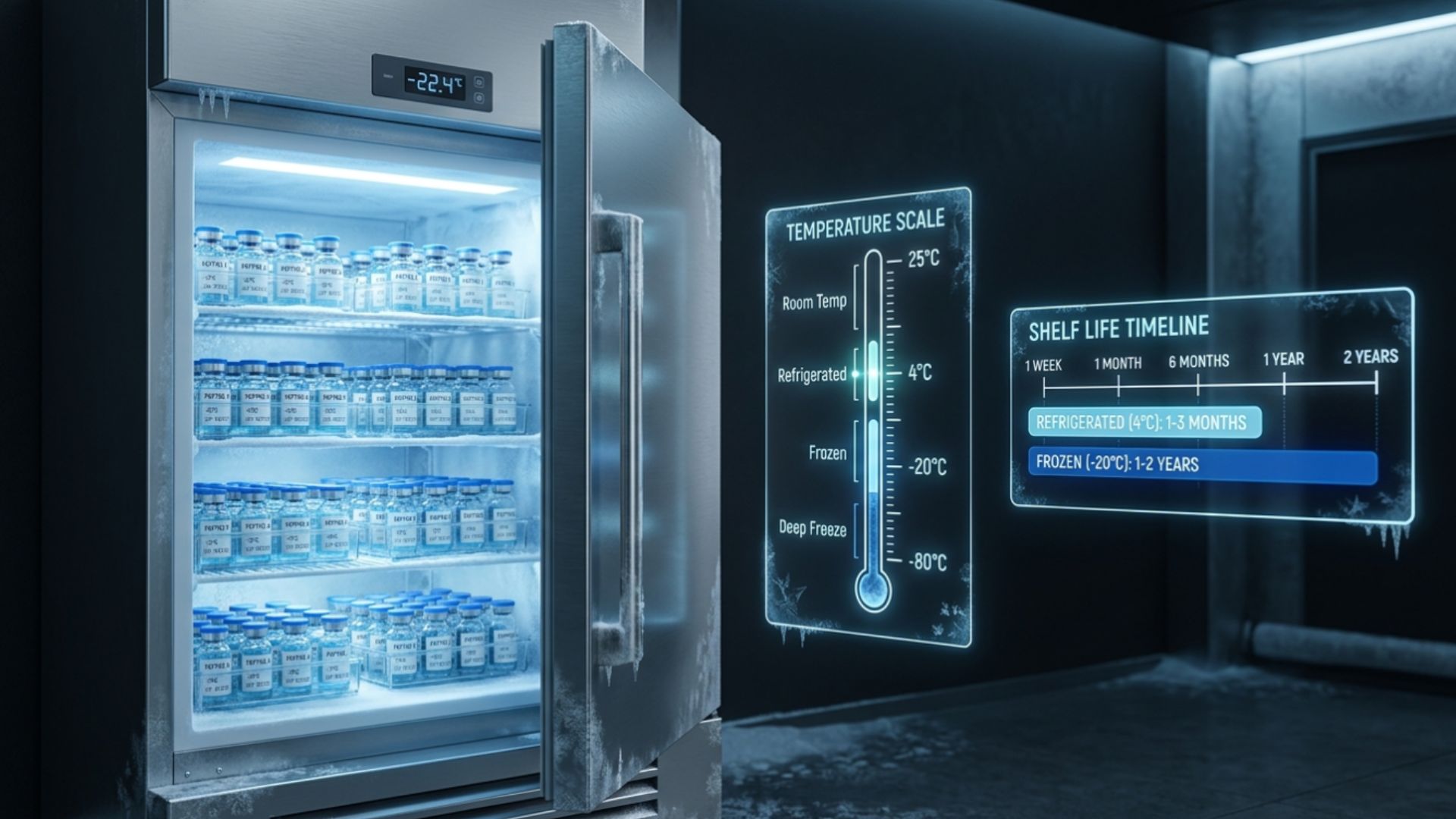
For long-term storage (anything beyond a few weeks), a freezer at -4°F to -20°F (-20°C to -29°C) is the standard recommendation. For shorter periods, a standard refrigerator at 35°F-40°F works. Room temperature is not a storage strategy; it’s just a way to degrade your investment slowly. Even in the more stable lyophilized form, prolonged exposure to ambient heat gradually chips away at peptide bonds.
Keep vials sealed until use, away from any light source, and ideally in their original packaging. Humidity is a real issue with powders – if moisture gets into a vial before reconstitution, it can start the very hydrolysis you were trying to avoid. A drawer in the back of the freezer, away from the door, is a better home for these than a shelf that gets exposed every time someone reaches for something.
How to Store Lyophilized Peptides for Maximum Shelf Life
For anyone running extended research protocols or buying in larger quantities, properly understanding how to store lyophilized peptides for the long haul is worth it.
Freezer storage at -20°F is the gold standard. Most lyophilized peptides remain stable for 18-24 months under these conditions, and some research suggests even longer for certain sequences, though 24 months is a reasonably conservative estimate for planning purposes. In the refrigerator, that window shrinks considerably: expect 3-6 months for most compounds before degradation becomes a meaningful concern.
A few practical details that matter: always let a vial reach room temperature before opening it. If you pull a cold vial directly from the freezer and open it, the temperature difference draws moisture through condensation, defeating the purpose. Give it 15-20 minutes on the bench, sealed, before you work with it.
How to store dry peptides and how to store powder peptides both come down to the same core principle – cold, dark, dry, and sealed until you’re ready to use them. A dedicated mini-fridge or freezer that doesn’t get opened constantly is genuinely worth it if you’re working with peptides regularly.
How to Store Peptides After Reconstitution: The Critical Window
Once you add bacteriostatic water to a lyophilized peptide, everything changes. The compound is now in solution, which means it’s exposed to water, vulnerable to microbial contamination, and significantly more sensitive to temperature and light than it was in powder form.
How to store peptides after reconstitution requires a different mindset than pre-reconstitution storage. The freezer is no longer your friend, because freezing a reconstituted peptide creates ice crystals that physically damage the molecular structure. A cold, consistent refrigerator is what you need, and “consistent” is the operative word. Temperature swings are harder on a peptide in solution than steady cold is.
Refrigerate immediately after reconstitution – 36°F to 46°F is the target range. Wrap the vial in foil or use an amber vial if you have one; UV exposure degrades peptide bonds in solution faster than most people expect. And draw from vials with a clean technique every time – every needle insertion is a potential contamination event.
Peptide shelf life after reconstitution for most compounds runs 2-4 weeks under proper refrigeration. Some peptides are more forgiving – BPC-157 tends to hold up reasonably well. Others, like GHK-Cu, are less stable in solution and should be used closer to the front of that window rather than the back.
How to store peptides in the fridge correctly also means thinking about where in the fridge the vial lives. The back of a shelf, away from the door, stays at a more consistent temperature than anything near the front.
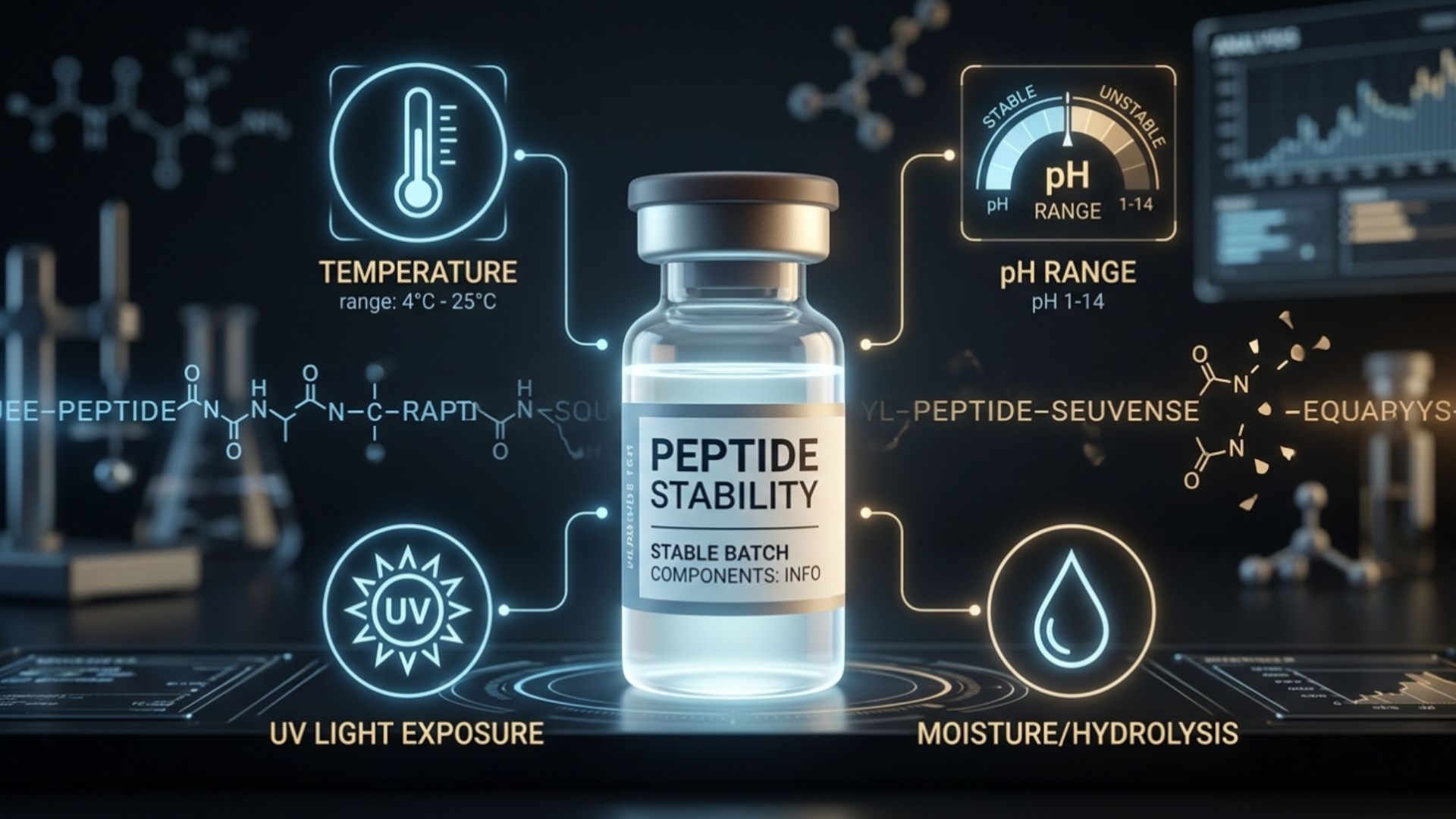
Understanding Peptide Stability and What Affects It
Peptide stability isn’t uniform across compounds – some sequences are inherently more durable than others based on their amino acid composition, chain length, and structural features. The main degradation mechanisms to understand:
- Heat accelerates almost every breakdown pathway – molecular kinetics speed up as temperature rises, which is why the difference between room temperature and refrigerator storage isn’t cosmetic.
- Light – particularly UV – directly damages the bonds between amino acids. This is why keeping vials dark matters, and why clear glass vials need to be wrapped or stored in a drawer.
- Oxygen causes oxidation of susceptible residues, which is most relevant post-reconstitution when the peptide is in open contact with dissolved oxygen in the solution.
- Moisture in lyophilized form triggers hydrolysis – the peptide bonds that hold the amino acid chain together start breaking in the presence of water. This is why contamination before reconstitution (e.g., from condensation) is a specific risk.
Microbial contamination post-reconstitution is probably the underappreciated one. This is exactly why bacteriostatic water – which contains 0.9% benzyl alcohol as a preservative – is preferable to plain sterile water for multi-use vials. Sterile water has no preservative action; once opened, it does not protect against microbial growth. Bacteriostatic water extends your usable window meaningfully.
How Long Do Peptides Actually Last? Realistic Shelf Life Expectations
Practical peptide shelf life numbers to work with:
- Lyophilized peptides stored at -20°F: 18-24+ months.
- Lyophilized peptides in a standard refrigerator: 3-6 months.
- Reconstituted peptides refrigerated at 36-46°F: 2-4 weeks for most compounds (some variation by peptide).
- Reconstituted peptides at room temperature: hours to a couple of days at most, and that’s being generous.
Peptide shelf life after reconstitution isn’t just a function of time – it’s a function of storage consistency, light exposure, reconstitution technique, and which compound you’re working with. Label every vial with the reconstitution date. It sounds obvious, and it’s the thing people most consistently skip. Three weeks in, when you’re looking at two unlabeled vials in the back of the fridge, you’ll wish you hadn’t.
Common Storage Mistakes That Ruin Peptides
Most storage failures aren’t dramatic. They’re small, consistent errors that gradually degrade product quality until a protocol produces inconsistent results and nobody can figure out why.
The biggest ones: leaving vials at room temperature after delivery instead of refrigerating or freezing immediately. Freezing reconstituted peptides – this one seems logical, but it’s wrong, and the ice crystal damage is real. Using sterile water instead of bacteriostatic water for multi-use vials, which removes the only microbial protection you have. Storing vials near the freezer door, where the temperature fluctuates every time it’s opened.
Repeated freeze-thaw cycles on lyophilized peptides are also an issue. If you’re pulling a vial from the freezer, bring it to room temperature, and decide you’re not using it yet – put it in the refrigerator, not back in the freezer. Each freeze-thaw cycle creates additional stress on the molecular structure.
And the one that causes the most problems in practice: not labeling reconstitution dates. How to store peptides correctly includes documentation, not just refrigeration.
Final Thoughts: Protecting Your Peptide Investment
Quality sourcing and quality storage are equally important – one doesn’t compensate for the other. A 99%+ purity peptide from a verified source degrades the same way as a cheaper one if it’s stored carelessly. Science doesn’t make exceptions for expensive vials.
The core rules stay consistent whether you’re working with one compound or ten: freeze lyophilized peptides for long-term storage, understand that how to store peptides before reconstitution and how to store peptides after reconstitution are genuinely different protocols, use bacteriostatic water for anything multi-use, keep everything away from light, and label every vial.
Peptide stability is the bridge between what the published research describes and what you actually observe in practice. Degrade the compound through poor storage, and you’re not running the same protocol the literature documented – you’re running a different experiment with an unknown variable.
We stock bacteriostatic water in 3ml, 10ml, and 30ml formats specifically because reconstitution matters, and sourcing it separately creates unnecessary friction. If you’re building a storage setup for the first time, a small dedicated mini-fridge – one that doesn’t get opened for anything else – is one of the better investments you can make.
Build a routine and label everything. How to store peptides in the fridge correctly becomes second nature quickly, and the payoff is research outcomes that actually reflect the compound you’re working with.