For most people starting a peptide cycle, the scientific aspect isn’t the hardest part. Nor is sourcing the products. The hardest part, the first time around, is looking at the syringe and actually giving yourself the injection.
Self-injection seems scary and strange until you do it once. After that, it’s just a skill no different from any other technique that seems unfamiliar at first but becomes routine after a week. Subcutaneous injections are specifically designed to be relatively painless and simple, which is why they are the standard method for administering research peptides.
Today’s article will be particularly helpful for beginners who are holding a syringe for the first time. Today, you will learn how to administer peptides subcutaneously, the step-by-step process, where and why to inject, at what depth, how often, and how a clean injection differs from a painful one. This guide is intended solely for research purposes – it is not medical advice. Anyone starting a peptide regimen should work with a qualified healthcare professional.
What Subcutaneous Injection Actually Means
How to inject peptides starts with understanding where the injection actually goes.
Subcutaneous means into the fatty tissue layer that sits just below the skin, above the muscle. This layer (also called the hypodermis) has fewer nerve endings and fewer blood vessels than muscle tissue, which is why SubQ injections are typically much less painful than intramuscular ones. It also absorbs compounds more slowly and consistently, which is exactly what most peptide protocols need: a steady, predictable release rather than a sharp spike.
For comparison, intramuscular (IM) injections go deeper into muscle tissue and produce faster absorption with a different release profile. Intravenous (IV) injections go directly into the bloodstream and are rarely used for peptides. For the vast majority of research peptide protocols – BPC-157, GHRPs, DSIP, GHK-Cu, and others – subcutaneous is the correct route.
How to inject peptides subcutaneously requires minimal equipment: insulin syringes in 29G or 31G gauge with a 1/2-inch needle, alcohol swabs, your reconstituted peptide vial, and a sharps container for disposal. The thin gauge and short needle length are specifically what make SubQ injections so manageable – this isn’t the kind of syringe that looks intimidating. It’s small, precise, and designed for exactly this purpose.
How Deep to Inject Peptides for Proper Absorption
How deep to inject peptides is one of the most common beginner questions, and the answer is simpler than most people expect.
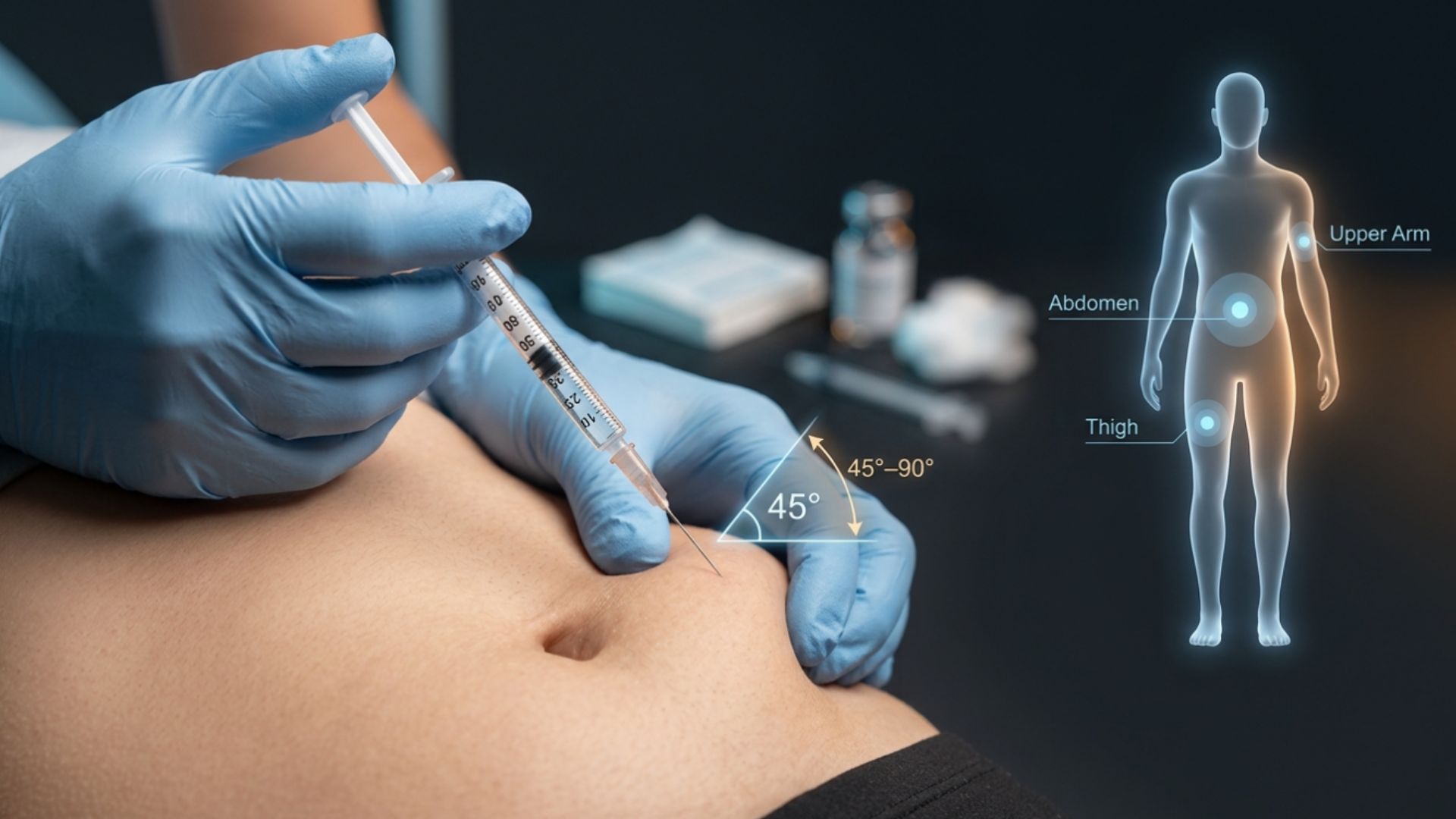
The subcutaneous fat layer is typically reached at just 4-6mm beneath the skin surface. A standard 1/2-inch insulin syringe needle is 12.7mm long, which is more than enough depth even at an angle:
- For most adults with a normal amount of body fat, inserting at 90° – straight in, perpendicular to the skin – reaches the SubQ layer without going into muscle.
- For very lean individuals with minimal fat at the injection site, a 45° angle reduces the risk of accidentally hitting muscle.

Best Injection Sites: Stomach, Thigh, and Beyond
How to inject peptides into the stomach – specifically the abdomen – is where most researchers start, and for good reason. The abdominal area has a reliable fat layer, easy access, and is straightforward to see and manage without help. The technique for how to inject peptides in the stomach: choose a spot at least two inches from the belly button, avoid any visible veins, scars, or stretch marks, and stay within the soft fatty area on either side. Subcutaneous peptide injection in the abdomen is considered the gold standard starting site precisely because the absorption is consistent and the technique is easy to execute correctly from day one.
How to inject peptides in the thigh is the next most common option. Use the outer middle third of the front of the thigh – not the inner thigh, which has more nerves and blood vessels, and not the back, where you can’t see what you’re doing. The front outer thigh has adequate fatty tissue for most people and stays away from the major muscle bulk. How to inject peptides in the thigh correctly means the same pinch-and-inject technique, the same angle considerations, and the same site-rotation logic.
Other viable options: the upper outer arm (though harder to self-inject) and the flank area. The principle across all sites is the same – fatty tissue, away from visible vasculature, rotated consistently.
Site Rotation and Why It Matters
Injecting the same spot daily creates problems that weren’t there before: scar tissue, fatty deposits, reduced local absorption, and persistent bruising. None of these is serious in isolation, but they accumulate.
A simple rotation works fine: left abdomen, right abdomen, left thigh, right thigh – cycling through in order. For protocols requiring multiple daily injections, use different quadrants of the same general region rather than the same point each time. Some researchers keep a brief log to track which site was last used. It takes thirty seconds and prevents weeks of tissue irritation.
How to safely inject peptides long-term comes down largely to this. The injection itself isn’t the problem; repetition in one spot is.
How Often to Inject Peptides: Timing and Frequency
How often to inject peptides is entirely compound-specific, and there’s no universal answer.
BPC-157 is typically injected once or twice daily due to its relatively short active window. GHRPs like Ipamorelin are often dosed before bed to align with the body’s natural overnight growth hormone pulse, which is when the signaling effect is most relevant. Ipamorelin + CJC-1295 No DAC is commonly paired with Ipamorelin in that same pre-sleep injection. DSIP similarly is timed to the pre-sleep window for its sleep-modulating effects.
Longer-acting compounds like Tesamorelin or CJC-1295 with DAC require less frequent dosing – sometimes two to three times per week rather than daily. The compound’s half-life determines the optimal dosing frequency.
Consistency matters more than perfect timing. Injecting at roughly the same time each day keeps the compound’s activity window predictable. Drifting by an hour occasionally isn’t a protocol failure – but switching between morning and evening randomly undermines what you’re trying to achieve.
Confirm the right frequency for your specific compound with a qualified professional before starting. Protocol design isn’t something to work out by trial and error.
Safety, Hygiene, and Final Tips for Confident Injections
A few things that make a real difference in practice.
Fresh needle every time. Never reuse a syringe – the tip dulls after one use, which is exactly what makes the second injection with the same needle more painful than the first. Clean both the vial stopper and the injection site with alcohol before every injection, and let both dry. Dispose of needles in a proper sharps container.
Watch what happens after the injection. A small welt or mild redness at the site for an hour is normal – that’s just local tissue response to the needle and the volume of solution. If you see persistent swelling, warmth, or any sign of infection developing over the following day, that needs medical attention, not a protocol adjustment.
Cold-numbing the site with ice for 30 seconds before injection reduces sensation if discomfort is an issue. Warming the vial in your hand for a minute before drawing reduces the sting of the cool solution. Neither is necessary, but both help some people.
How to safely inject peptides and how to properly inject peptides are both learnable in a single session. The first injection is always the hardest – not because it’s difficult, but because it’s unfamiliar. Source your supplies from verified vendors, follow the process, and it becomes routine faster than you’d expect.