Cell biology has a reputation for being complicated. But once you start tracing what actually happens inside a living cell, it becomes one of the most interesting subjects in modern science. Right at the center of that machinery sits a molecule that most systems depend on to function: nicotinamide adenine dinucleotide, better known as NAD+.
At Iron Peptides, we manufacture compounds that researchers use every day, and NAD+ consistently ranks as a genuine biochemical cornerstone. This article breaks down what science actually says. Everything here is strictly educational and does not constitute medical advice of any kind.
What Is NAD Peptide? Understanding the Terminology
Before getting into the biology, it’s worth addressing the terminology confusion that shows up everywhere: in search queries, research databases, and supplier catalogs. Is NAD a peptide? In strict biochemical terms, no. And understanding that distinction is actually a solid place to start.
Here’s a simple breakdown:
- Peptides are short chains of amino acids linked by peptide bonds, essentially fragments of proteins at the molecular level.
- Coenzymes are non-protein organic molecules that work alongside enzymes to catalyze biological reactions inside cells.
NAD+ contains adenine and nicotinamide. There’s no amino acid chain involved, which means no peptide classification applies. So when researchers ask whether NAD+ is a peptide, the biochemically accurate answer is no.
Then why does the phrase NAD peptide appear so consistently across catalogs and research literature? Because NAD+ is routinely studied alongside peptides – particularly in the context of metabolic health and cellular longevity. It attracts the same research audience, gets grouped into the same catalog sections, and appears in the same experimental designs. The label is an industry convention, not a chemical fact.
Understanding what the NAD+ peptide is in this dual sense – technically a coenzyme, practically embedded in the peptide research ecosystem. It helps anyone navigating this field avoid unnecessary confusion when reading the literature.
What Does NAD Peptide Do in the Body?
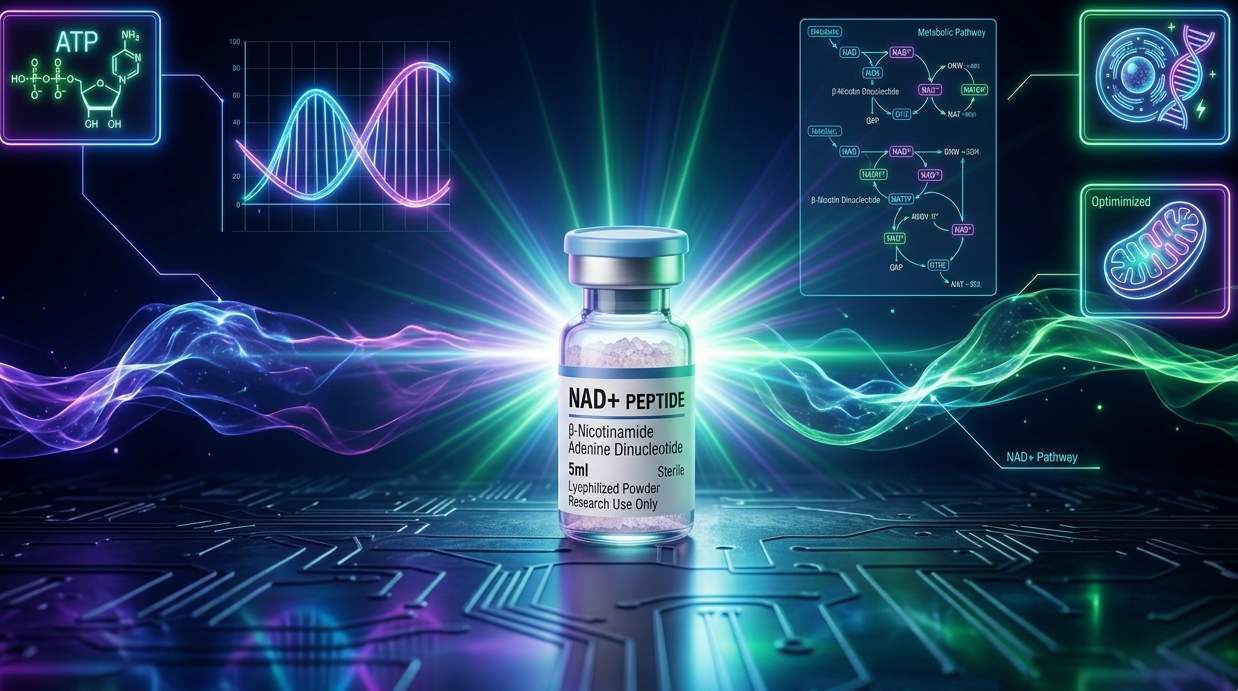
NAD+ is present in every living cell. Its primary job is electron transport. NAD+ toggles between two states: NAD+ (the oxidized form) and NADH (the reduced form), acting as a molecular shuttle that continuously moves electrons through the metabolic pathways that keep cells alive. Without that shuttle, the pathways that generate cellular energy can’t operate.
When researchers examine the NAD+ peptide, what does it do at a mechanistic level? Three functions appear consistently in the literature:
- Transferring electrons from nutrients into the pathways that synthesize ATP (the cell’s primary energy currency).
- Serving as a required cofactor for sirtuins, a family of enzymes involved in gene expression regulation, stress response, and cellular homeostasis.
- Supporting cellular homeostasis – the stable internal environment that cells need to survive and function normally.
What does NAD peptide do when levels are optimal versus depleted? That gap in cellular behavior is exactly what researchers are actively mapping, and it sits at the center of scientific interest in this coenzyme.
NAD+ and Mitochondrial Function
Mitochondria generate the majority of a cell’s ATP, and that process is entirely dependent on NAD+ availability. Without adequate coenzyme supply, the electron transport chain, the final stage of ATP synthesis, cannot effectively process nutrients. The entire energy production system slows down.
One area that deserves particular attention is mitophagy – the selective recycling of damaged mitochondrial components. Healthy cells use this internal quality-control mechanism to remove dysfunctional parts. The data suggest that adequate NAD+ levels are necessary for this process to work properly. When levels decline, the signaling loop between the cell nucleus and mitochondria becomes disrupted – a pattern researchers observe consistently in cellular aging models.
This is why NAD+ peptide benefits in scientific literature extend beyond energy output alone. They touch on cellular maintenance, structural integrity, and the feedback systems that determine a cell’s resilience under long-term stress. At Iron Peptides, every product is synthesized with this mechanistic context in mind. Understanding biology isn’t a marketing angle; it’s the foundation of manufacturing materials that are actually useful in real research settings.
NAD+ Peptide and Energy Metabolism
The metabolic role of NAD+ peptide is where textbook biochemistry and cutting-edge research overlap most directly. Two foundational pathways illustrate this clearly.
- Glycolysis – the enzymatic breakdown of glucose, which releases energy and forms pyruvate. At this stage, NAD+ accepts electrons, becoming NADH.
- The Citric Acid Cycle (Krebs Cycle) – a series of cyclic reactions in aerobic organisms that extract additional energy from acetate. NAD+ again serves as the key electron acceptor at multiple points throughout the cycle.
Once electrons have been collected across both pathways, NADH delivers them to the electron transport chain, where the bulk of ATP synthesis occurs. The coenzyme then returns to its oxidized NAD+ form, and the cycle repeats continuously across billions of cells at every moment of life.
The NAD peptide benefits studied in metabolic research are fundamentally tied to the efficiency of this cycle. Researchers track how cells behave at different coenzyme concentrations and observe the downstream effects in real time. The logic is clean: support the shuttle, support the cycle, support energy output. Biology is complex, but the principle is elegant, and that clarity partly explains why scientific interest in NAD+ has grown so consistently year over year.
NAD Anti-Aging Research: What the Science Is Exploring
This is where the topic gets genuinely compelling and where the scientific community is right to be careful.
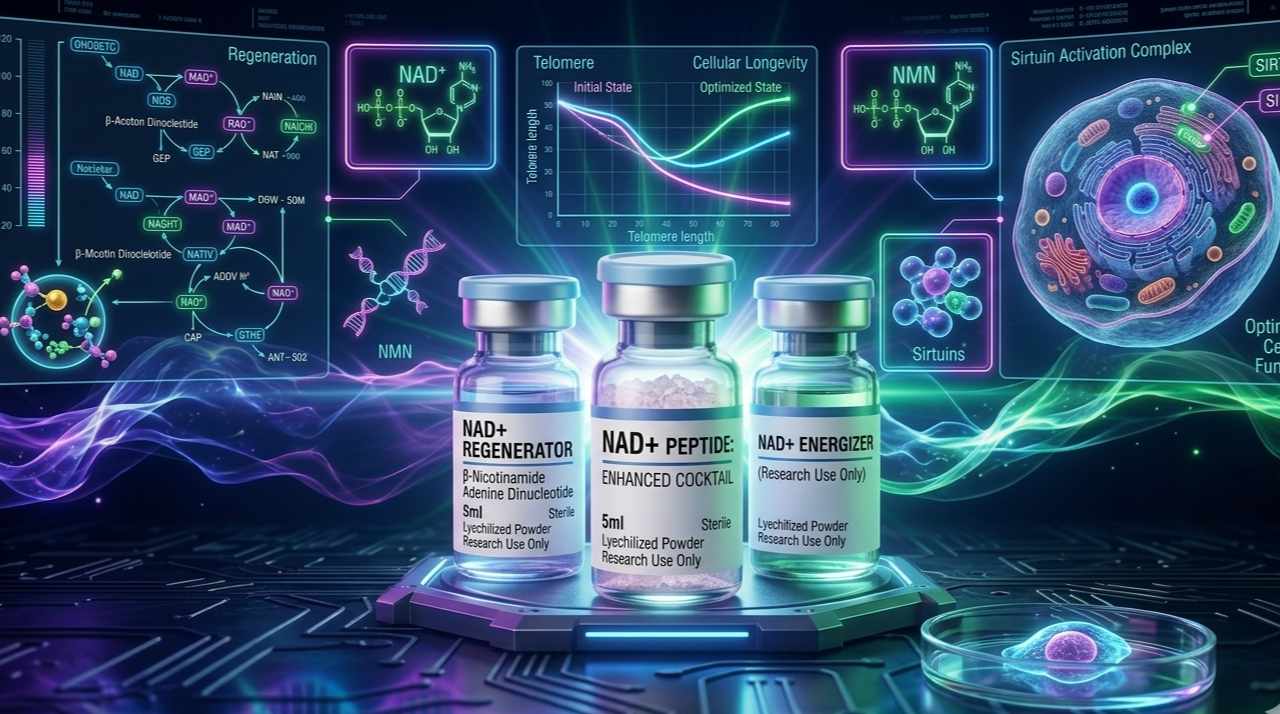
NAD+ levels naturally decline as organisms age. That’s been documented consistently across multiple species. The open research question is what exactly that decline means for cellular aging, and whether maintaining higher levels alters that trajectory in meaningful ways.
NAD anti-aging research currently focuses on cellular senescence – the process by which cells stop dividing and enter a functionally altered state that affects surrounding tissue. Animal model experiments have produced interesting patterns. But translating preclinical findings into human clinical outcomes requires patience and rigor. Success in model organisms does not automatically predict human results.
NAD+ peptide benefits in the anti-aging research context are about understanding cellular timelines and biological processes, not making longevity promises. The questions being asked are well-grounded, the mechanisms are biologically coherent, and the data are accumulating. That’s meaningful groundwork, even if definitive clinical conclusions are still being shaped.
NAD+ and Cellular Repair Pathways
One of the most technically interesting branches of NAD+ research involves PARPs – poly ADP-ribose polymerases. These proteins activate in response to DNA damage, running repair operations when cells encounter environmental stressors. PARPs depend entirely on NAD+ as their energy source to do this work. When damage occurs, they consume the coenzyme during repair.
This creates a notable dynamic: demand for NAD+ spikes precisely when cells are under the most stress. The coenzyme is needed simultaneously for energy production and consumed by the repair system. Researchers studying DNA integrity, genomic stability, and cellular resilience keep arriving at NAD+ because it sits at the intersection of two critical systems.
It’s a remarkable biological fact, and one that helps explain why scientific interest in this molecule continues to grow year after year.
NAD+ Peptide Dosage and Forms: What People Commonly Ask
To be direct about this section: it does not contain specific numerical recommendations. Questions about NAD+ peptide dosage per day or the optimal NAD+ peptide dosage for any research application are decisions for qualified scientists and licensed medical professionals. A specialized dosage calculator and proper professional oversight are the right tools for those questions.
What is worth discussing are the formats that appear in research contexts. In laboratory settings, NAD+ is used in various forms depending on experimental design. The NAD peptide injection method, for example, is used in controlled animal studies with specific goals around absorption and systemic distribution. Different administration formats produce different bioavailability and stability profiles, which is exactly why study design and compound quality matter equally.
All Iron Peptides products come with third-party-verified Certificates of Analysis (COAs), confirmed by HPLC and mass spectrometry, with 99%+ purity guaranteed. Rigorous quality control isn’t optional. It’s the minimum standard for materials researchers actually rely on.
NAD+ Peptide Benefits: Key Points and Common Questions
To close out the key questions that come up most often around this topic:
What is NAD peptide, is it actually a peptide?
No, it’s a coenzyme. It appears in the same research catalogs and studies as peptides because it’s investigated alongside them in the context of metabolic and cellular health. The term reflects an industry convention rather than a molecular classification. Understanding this distinction helps researchers engage with the literature more precisely.
What are the main research focus areas for NAD peptide benefits?
Scientific literature consistently highlights three: ATP production through the electron transport chain, cofactor activity for DNA repair enzymes (primarily PARPs), and mitochondrial maintenance, including nucleus-to-mitochondria signaling. These are central topics in cell biology, not peripheral areas of investigation.
Why does NAD+ decline matter for anti-aging research?
Because it’s tied to processes – sirtuin activity, mitochondrial signaling, DNA repair – that directly affect how cells handle stress over the long term. The mechanisms are coherent and well-supported by data. Clinical conclusions continue to develop.
What is the proper context for working with these compounds?
These are research tools for use in in vitro settings and controlled laboratory experiments. Any application beyond that context requires professional oversight. That’s not a disclaimer to scroll past; it’s the real boundary of responsible use.
Final Educational Notice! All content in this article is provided strictly for educational and informational purposes. Nothing here constitutes medical advice and is not intended to diagnose, treat, cure, or prevent any medical condition. The materials discussed are intended for research use only and for in vitro applications and have not been approved by the FDA for therapeutic use. Always consult a qualified medical professional before making any decisions involving supplements or research compounds.