Here’s something that doesn’t get said enough: almost everything written about peptides for men. Bodybuilding communities, testosterone protocols, aggressive recomposition stacks. The assumed reader was always male.
So what happens when a woman in her late 40s, dealing with sleep disruption, stubborn belly fat, and joint pain that wasn’t there three years ago, tries to find relevant information? She gets content that technically covers the same compounds, but was never built around how her body actually works. That’s a real gap, and it’s worth addressing honestly.
Female physiology isn’t just “male physiology with different hormones.” The hormonal swings across a menstrual cycle, the cascade of changes through perimenopause, the way stress and cortisol interact with estrogen – these create a genuinely different biological environment. Research chemicals behave accordingly.
What Are Peptides for Women and Why They Work Differently
What are peptides for women, stripped of all the marketing language? They’re short amino acid chains that the body uses as signaling molecules. Think of them as messages – they tell specific cells to do specific things. Produce more of this hormone, repair this tissue, dial down inflammation here.
What makes them different from synthetic hormones or anabolic steroids is that they don’t bulldoze the system. They work with existing biological pathways rather than overriding them. For women, that distinction is especially meaningful. The female hormonal environment is finely tuned – mood, energy, fertility, sleep quality, and even appetite are all connected to it. Something that disrupts that balance aggressively can cause problems that are worse than whatever it was supposed to fix.
The benefits of peptides for women come precisely from that specificity. A few broad categories appear consistently in the research:
- Growth hormone secretagogues (such as CJC-1295 and ipamorelin) that support sleep and cellular repair
- Healing compounds like BPC-157 and TB-500 for tissue recovery
- Metabolic regulators, including GLP-1 receptor agonists
- Skin-focused compounds like GHK-Cu
Then there are more specialized options – kisspeptin for endocrine signaling, PT-141 for central nervous system pathways tied to libido.
Peptides for Menopause – Supporting the Hormonal Transition
Menopause doesn’t arrive cleanly. For most women, it’s a years-long process – perimenopause first, with its unpredictable hormonal swings, then the more stable (but lower baseline) post-menopausal state. Along the way: disrupted sleep, shifting fat distribution, declining muscle tone, skin changes, and mood shifts. The list is long, and the experience is exhausting.
Peptides for menopause have drawn real research interest because they can target specific physiological declines without directly manipulating estrogen or progesterone. One well-documented change with age is a drop in growth hormone secretion and that drop has downstream effects on sleep quality, body composition, and tissue repair. Compounds that stimulate the pituitary gland to restore more natural secretion patterns have shown relevance in studies examining these areas.
Peptides for menopause weight loss sit in a slightly different category. The metabolic frustration women describe during this period is hormonal. Declining estrogen changes how the body handles insulin, where it stores fat, and how efficiently it processes nutrients. GLP-1 receptor agonists and certain growth hormone fragments address these mechanisms directly, not by restricting intake but by working with metabolic biology.
Kisspeptin is worth mentioning, too. It regulates signaling along the hypothalamic-pituitary-gonadal axis – a pathway involved in body temperature regulation and reproductive hormone regulation. Research is still developing here, but it’s a genuinely interesting area.
Weight Loss Peptides for Women – What Actually Works
Weight resistance in women often stems from factors a calorie calculator won’t show. Insulin sensitivity shifts, cortisol patterns change, growth hormone declines. These aren’t character flaws – they’re physiological realities, and treating them that way is the starting point for actually useful research.
Weight loss peptides for women are most relevant when matched to the underlying mechanism. GLP-1 receptor agonists work at the intersection of insulin signaling and appetite regulation; they slow gastric emptying, improve how the body handles blood sugar, and reduce signals that trigger hunger. Clinical trial data from female cohorts show real reductions in visceral fat, the metabolically active kind that accumulates around the abdomen.
Growth hormone fragments like AOD-9604 take a different approach – interacting directly with fat cells to activate lipolysis, without affecting insulin or blood sugar. That specificity matters to women concerned about metabolic health alongside body composition.
Peptides for weight loss in women don’t work in isolation, though and this part often gets glossed over. Pairing any metabolic compound with adequate protein and resistance training isn’t just a suggestion. Women are more vulnerable to muscle loss during aggressive fat loss than men, and lean mass is critical for long-term metabolic rate, bone density, and functional strength.
Best Peptides for Female Muscle Growth and Recovery
Let’s clear something up: the best peptides for female muscle growth have nothing to do with the androgenic steroids that dominate male bodybuilding content.
What women are typically researching here is lean tone, structural definition, strength that holds up over time. Growth hormone secretagogues are a natural starting point. They stimulate the pituitary to release its own stored growth hormone, avoiding the artificial spikes associated with synthetic injections. Results in peptides for women’s muscle growth research are described as gradual and progressive, better muscle tone and recovery capacity developing over weeks rather than dramatic overnight changes.
Recovery compounds are where things get particularly interesting. BPC-157 is one of the most-studied options in this space – it accelerates healing in tendons, ligaments, and muscle tissue. Also, it supports gut lining integrity, which can be surprisingly relevant during periods of hormonal stress. TB-500 (derived from thymosin beta-4) promotes cell migration and tissue repair after intense physical effort.
For women experiencing the natural dip in recovery capacity that comes with hormonal fluctuations, whether that’s premenstrual, perimenopausal, or post-menopausal, these compounds address a very real physiological need.
Peptides for Libido and Hormonal Balance in Women
This topic deserves more direct conversation than it usually gets. Female libido is genuinely complex. Neurotransmitter activity, sleep quality, stress load, relationship dynamics, neurochemical balance – all of it feeds into the picture. When hormones shift during perimenopause or after menopause, desire doesn’t just decrease; it often changes in ways that feel disconnected from everything else happening in life.
Peptides for libido women offer a research pathway into this problem that doesn’t rely on direct hormone replacement. PT-141 (bremelanotide) has the most developed evidence base here. It works centrally – activating melanocortin receptors in the brain to engage pathways associated with arousal and desire. Research specifically in pre-menopausal women with hypoactive sexual desire disorder has produced meaningful data.
Kisspeptin addresses the endocrine side – regulating the signaling axis that manages downstream reproductive hormone balance and some aspects of energy-related motivation.
One terminology note worth making: testosterone peptides for women is a phrase that comes up in research conversations, but it’s not technically accurate. Testosterone is a steroid hormone, not a peptide. Certain peptides can support hormonal environments, including the androgen baseline, through indirect signaling pathways. That’s a meaningful distinction for anyone working in this research area.
Anti-Aging Benefits of Peptides for Women
After 40, the pace of certain biological changes accelerates noticeably. Estrogen decline drives collagen loss – research suggests a roughly 30% reduction in skin collagen density in the first few years following menopause. The visible effects follow: thinner skin, slower healing, reduced elasticity, changes in hair thickness and quality.
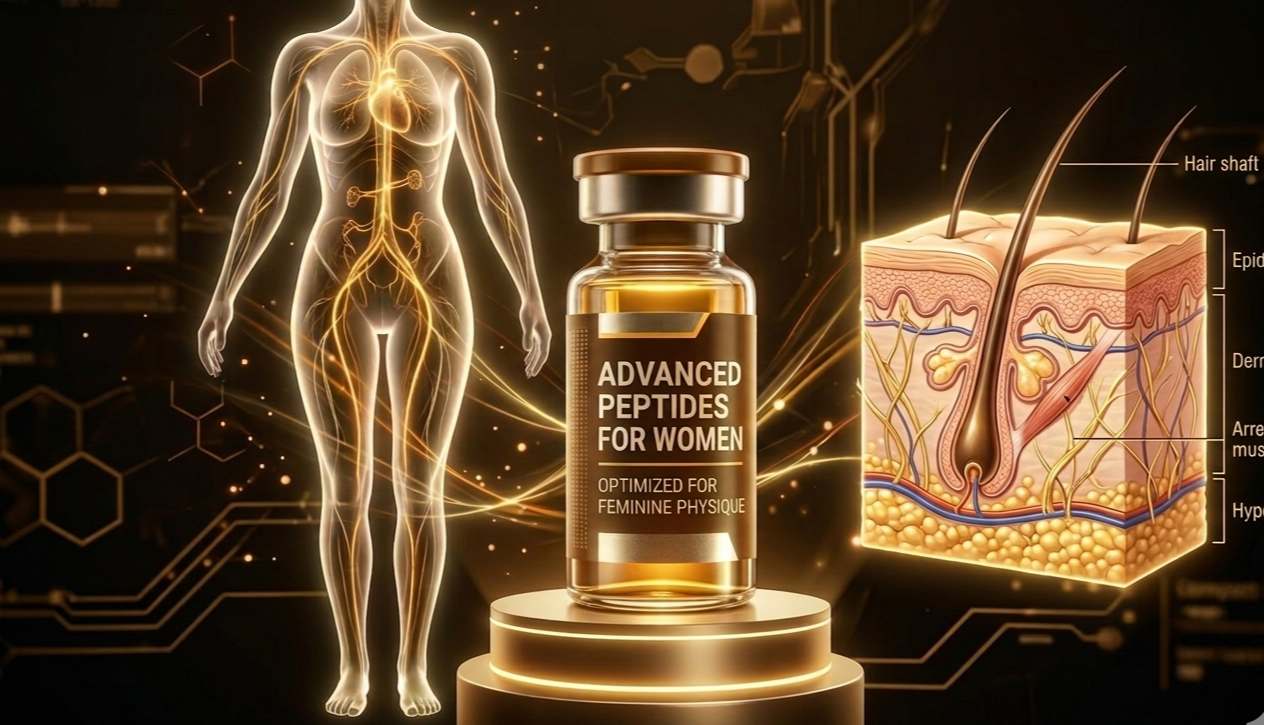
GHK-Cu (copper peptide) addresses this at the cellular level. It stimulates collagen and elastin production, supports tissue remodeling, and aids hair follicle function. It’s one of the better-researched options for women focused on the biology of skin aging rather than surface-level treatments.
Epitalon works differently – it’s studied for its interaction with telomerase activity, which relates to how cells manage the replication process over time. Thymosin Alpha-1 rounds things out from an immune system perspective, supporting a function that naturally weakens with age.
These aren’t cosmetic fixes. They’re interventions at the cellular mechanism level – and that distinction is exactly what serious research is built on. At Iron Peptides, every product we manufacture comes with a third-party Certificate of Analysis verified through HPLC and mass spectrometry.
Best Peptides for Women Over 40 vs Over 50 – Age-Specific Protocols
The best peptides for women over 40 aren’t automatically the right research compounds for women in their 50s. Life stage genuinely changes what’s relevant.
Through perimenopause – roughly the early-to-mid 40s for many women – the dominant concerns are sleep disruption, early metabolic shifts, and the beginning of visible tissue changes. Research at this stage typically focuses on compounds that restore natural growth hormone patterns, preserve skin and connective tissue integrity, and support metabolic efficiency, which starts to slip during this transition.
Peptides for women over 50 operate in a different context. Estrogen has stabilized at a lower baseline, and the physiological priorities shift – bone density, muscle preservation, joint health, and cardiovascular markers become more central. Research protocols in this range frequently include GLP-1 compounds for insulin resistance and weight management, PT-141 (kisspeptin) for libido and endocrine regulation, and BPC-157 for joint protection and gut integrity.
Beyond 60, sarcopenia – the gradual, age-related loss of muscle mass – becomes the primary concern. The research framework here consistently combines growth hormone secretagogues with regular resistance training, which together show the strongest support for maintaining mobility, balance, and metabolic function in later life.

Choosing the Best Peptides for Women – A Practical Framework
Finding the best peptides for women isn’t about picking whatever gets mentioned most often online. It’s about matching a compound to a specific goal and understanding which biological markers are worth tracking to know whether the research is actually telling you something useful.
| Primary Goal | Research Compounds | Biomarkers to Track |
| Metabolic Support & Fat Loss | GLP-1 agonists, AOD-9604 | Fasting insulin, waist circumference, HbA1c |
| Muscle Tone & Deep Sleep | CJC-1295, Ipamorelin, Sermorelin | Sleep cycles, lean mass, waking energy |
| Tissue Repair & Gut Health | BPC-157, TB-500 | Recovery time, joint comfort, digestive markers |
| Skin & Cellular Anti-Aging | GHK-Cu, Epitalon | Skin elasticity, hair thickness, inflammatory markers |
| Libido & Endocrine Balance | PT-141, Kisspeptin | LH/FSH balance, subjective wellbeing scores |
Whatever compounds you’re sourcing for research, quality documentation matters. Independent, third-party Certificates of Analysis are the minimum standard – not a bonus feature.
All compounds discussed in this article are for laboratory research purposes only. They are not approved for human consumption, medical diagnosis, or therapeutic use. This content is educational. Always consult a qualified medical professional before beginning any health or research protocol.